
BabyNet++ (Fetal Birth Weight Prediction)
Problem
Case Study: Transforming fetal birth weight estimation with AI – BabyNet++
BabyNet++ represents a breakthrough in computational medicine. It shows how AI can bridge the gap between medical imaging and clinical decision-making. By leveraging advanced deep learning techniques, we have created a scalable, accurate, and clinically valuable tool that enhances perinatal care. This achievement showcases our expertise in computational medicine and our commitment to delivering AI-powered solutions that directly impact patient outcomes.
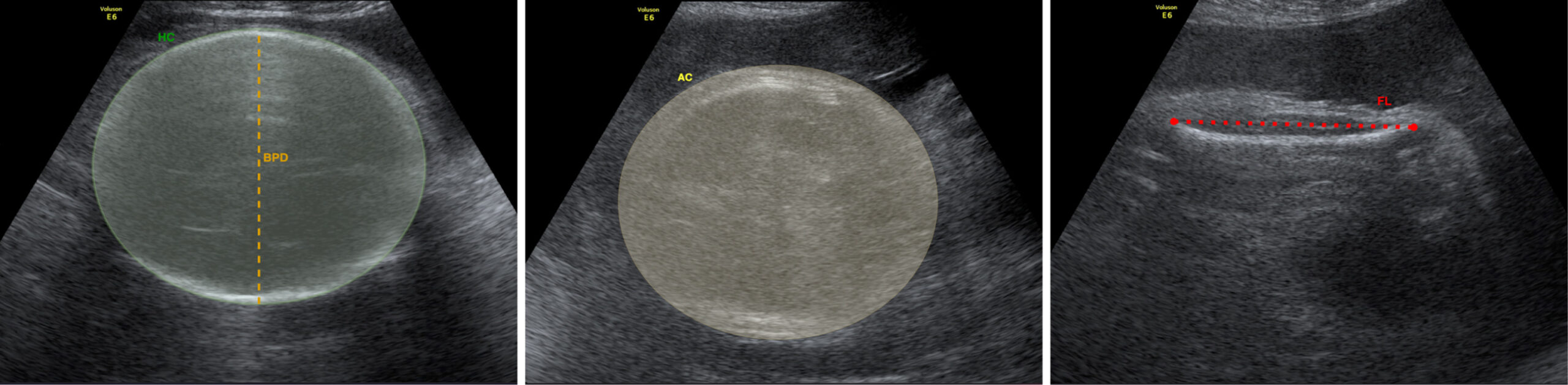
The challenge: Improving accuracy in fetal birth weight estimation
Accurate estimation of fetal birth weight (FBW) is critical for perinatal care, influencing decisions on delivery timing and method. Traditional ultrasound-based approaches, while widely used, have significant limitations. Current clinical methods can have an error margin of up to 15%, leading to potential misdiagnoses of low birth weight (LBW) or macrosomia, both of which can increase the risk of complications for newborns and mothers. Additionally, variability in manual biometry measurements and inconsistent training among sonographers make it difficult to standardize predictions across different healthcare settings.
Solution
BabyNet++ – AI-powered precision in fetal birth weight prediction
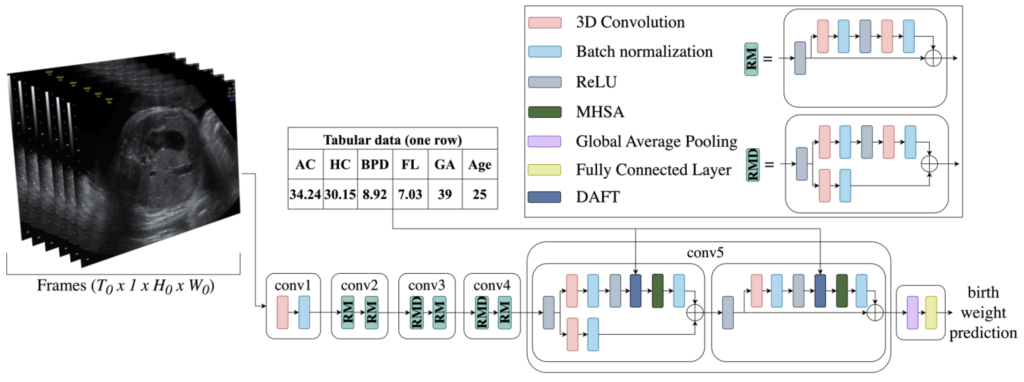
To address these challenges, our Sano team, including Szymon Płotka, Michał Grzeszczyk and external collaborators, including Robert Brawura-Biskupski-Samaha, Paweł Gutaj, Michał Lipa, Tomasz Trzcinski, Ivana Isgum, Clara I. Sanchez and Arkadiusz Sitek developed BabyNet++, an advanced AI model designed to enhance the accuracy of FBW estimation. BabyNet++ integrates ultrasound video scans and clinical data, leveraging deep learning to provide more reliable and standardized predictions compared to traditional methods. By incorporating a transformer-based neural network, BabyNet++ effectively analyzes spatio-temporal features in ultrasound videos, mitigating issues related to measurement variability and observer-dependent errors.
Study cohort: Real-world validation of BabyNet++
To ensure the reliability of our approach, BabyNet++ was trained and validated using a multicenter dataset that included:
- 582 ultrasound video scans
- Clinical data from 194 patients
- Scans performed within 24 hours before delivery
- Data collected from multiple healthcare facilities to ensure model generalizability
This diverse dataset enabled us to test BabyNet++ across various clinical scenarios, ensuring robust performance in real-world settings.
Steps Taken: Developing and Validating BabyNet++
1. Data collection:
- Gathered fetal ultrasound video scans and clinical records from multiple hospitals, including University Centre of Mother and Child’s Health of the Medical University of Warsaw, Poznan University of Medical Science, Centre of Postgraduate Medical Education in Warsaw, and Holy Family Hospital in Warsaw.
- Standardized clinical parameters to reduce variability in input data.
2. Model development:
- Designed a transformer-based AI architecture to analyze ultrasound videos.
- Integrated a residual transformer module with a dynamic affine feature map transform, allowing the model to capture complex fetal growth patterns.
3. Training and validation:
- Trained the model using historical birth weight data as ground truth.
- Evaluated performance against existing FBW estimation methods.
- Fine-tuned the AI system to improve robustness and reliability.
4. Clinical testing:
- Compared BabyNet++ predictions with traditional sonographic estimations.
- Assessed usability and integration potential within hospital workflows.
Value added to medicine and healthcare
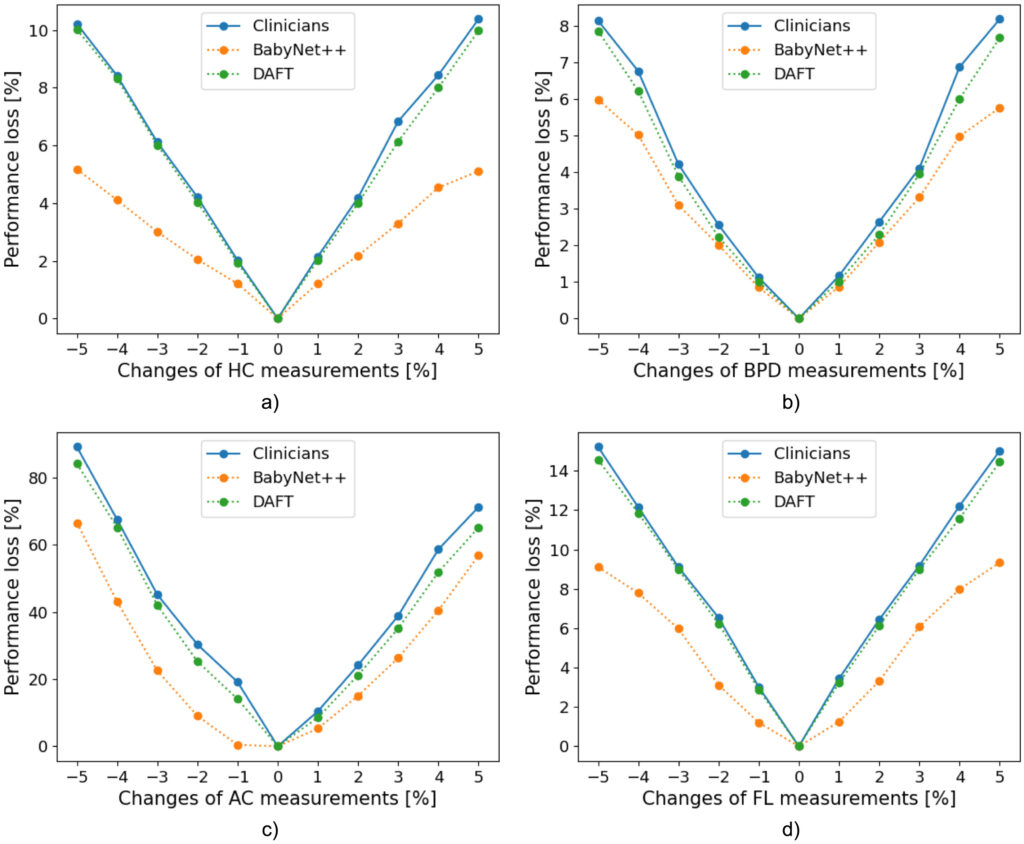
- Increased Accuracy: BabyNet++ significantly reduces prediction errors, providing clinicians with a more reliable tool for fetal weight estimation (5.1% of mean absolute percentage error).
- Standardization of diagnosis: By eliminating observer variability, BabyNet++ ensures consistent and objective FBW predictions across different medical centers (0.6 % of standard deviation of mean absolute percentage error across all centers).
- Improved decision-making: More precise weight estimation helps obstetricians plan safer deliveries, reducing the risk of unnecessary cesarean sections or complications due to undiagnosed LBW/macrosomia.
- Enhanced clinical workflows: BabyNet++ can be integrated into existing hospital ultrasound systems, improving efficiency and streamlining perinatal care practices.
- Scalability and accessibility: With proper implementation, BabyNet++ has the potential to assist less experienced clinicians in rural or under-resourced hospitals, ensuring equitable healthcare outcomes.
BabyNet++ (Fetal Birth Weight Prediction)
Szymon Płotka
Szymon’s research interests lie at the intersection of computer vision, machine learning, and deep learning-based algorithms for medical image analysis. He is particularly interested in developing innovative AI-driven solutions that enhance diagnostic accuracy, integrate diverse data sources, and optimize healthcare workflows. His work aims to bridge the gap between cutting-edge artificial intelligence and practical clinical applications, contributing to more efficient and accessible medical imaging technologies.
Szymon earned his PhD in Computer Science in 2024 from the Informatics Institute at the University of Amsterdam. His research focused on using deep learning to improve prenatal care. His doctoral thesis, titled “Enhancing Prenatal Care Through Deep Learning,” investigated advanced machine learning algorithms for medical image analysis, particularly focusing on applications in fetal video ultrasound imaging.
